Saturday, February 18, 2012

Wok i Kik: A Work Update

I follow a number of different blogs: friends of mine from before Peace Corps and PCVs I am currently serving with. Everyone I follow is a friend or past acquaintance of mine working internationally, in some shape or form, as an Aid/Development worker and I’ve started to notice a trend: I feel like the only ‘blogger’ – yeah, that is a horrible word – that never starts a blog with “Today at the office…” This is made impossible by my situation; when I wake up for work, it is completely up to me and my own independent thoughts to decide what work I will do – sounds great, huh? I can’t tell you how much I want a 9 – 5 job right now with a set of objectives, goals, and deadlines (we do have these in our project framework, but deadlines are non-existent). That way if I finish my work and slack off, I will still feel accomplished. Now I can’t slack off or I feel the looming shadow of guilt. Bah! Thus, I spend my days and weeks working on everything I can and eventually realizing that I have burnt out all possibilities of additional work way too early and thus the cycle begins again: work frenzy, work, rest, guilt, work frenzy, work, rest, guilt, etc. etc. Never thought I would be demanding a 9 – 5, but any structure would be nice – I really appreciate structure (it’s an OCD-perfectionist thing). Don’t get me wrong, I appreciate the freedom and trust Peace Corps gives us (some might say ‘has to give us’ – considering the island set-up). I am allowed to make my own professional decisions regarding my development projects and nothing could be more empowering. I just want some structure every now and then. Whatever, complaining isn’t going to get me anywhere, so I continue working to the best of my ability and creativity. Now, to waste no further time (because you probably have a 9 – 5 and loath me now): today at the office…

Everybody Poops: Thanks Australia High Commission

Well it’s true. Australian High Commission and thus the Government of Australia and the good people of Australia have funded the construction of 83 Ventilation-Improved (VIP) Toilets thus making sure the people of Naviso have some really nice holes to poop in. The Australian High Commission Direct Aid Programme used approximately 350,000 VT (4,000 USD) to buy all of the cement, PVC pipes, nails, black paint, vent cowls, and freight costs to ship the materials to Naviso. Now we are waiting on one of the two ships (Aurora or Huvutu) to make a Copra-run and thus bring all cargo to Naviso. This was always going to be the problem – I even stated in the application – without consistent ship travel it’s hard to determine what time a ship will come to Naviso. With an April 30th Deadline this becomes more pertinent (though I believe they will be lenient on this one). During my time in Port Vila, I’m going to have to try and figure out the time the ship will be coming via Reynold (Maewo’s Copra Mill Agent) and the Copra Mill; additionally, I will have to communicate this information to Norman at Santo Hardware to try and set-up a time to get the materials on a ship coming to Naviso. Moreover, I’m not quite sure how Australian High Commission plans to freight. I will be tidying these things up during February and hopefully work can start late February or March.
During early January, I trained the Village Toilet Committee (charged with leading this project) in the exact specifications for the VIP Toilets with the available materials. I have no illusions this project will be easy, but I think in the end it will be an accomplishment of note for the community; because of the significance of the project for the community, I want to make sure everything goes well and we finish all 83 toilets, but I know that development projects don’t always work out perfectly and in Vanuatu many things can interfere with progress, so I’m not raising expectation to much… Hah! Yeah right! My expectations are sky high and I’m really just constantly worried about everything involved with the project. The hardest part will be getting the materials to Naviso. As soon as that happens I think I will be able to breathe again. Once the materials get here I believe the construction will fall into place; like any kind of work in Vanuatu: it won’t be conventional, but it will get done.  

Laying Pipe in Vanuatu: Water for Life

The PCPP for a new gravity-fed water system in Naviso officially started raising money in November and as of now we’ve raised 200,000 VT (approx. 2,000 USD). We need to raise approximately 1,060,000 VT (approx. 11,500 USD) so we definitely have some time to wait, but in the end we will be able to build the new water system and that’s the important part. Unfortunately, at the rate we are raising money I might be extending, in Naviso, for a few years. Once the money is raised we can approach Rural Water Supply (RWS) and start a program for constructing the new pipeline.

During November I used the GPS Lindsay borrowed from RWS to conduct the water supply survey for RWS. I went to the old water source and three new water sources. Additionally, I marked the main areas of the village on the GPS. The survey required me to mark the GPS location, elevation of source, elevation to main village, measure the flow rate (liters/second), and mark any other observation about the source. Additionally, I conducted a H2S Test – testing the water for bacterial contamination (unfortunately the test does not tell you what kind of bacteria) – and I kept a photographic record of the water sources. Lindsay was able to take the survey into RWS in Port Vila when she went back to America for Christmas. During February, I will be following up, for the both of us, with RWS. Hopefully, the survey will allow for a more accurate design and budget for the proposed water supply. Now we can only wait.   

S-E-X Spells: A Mighty Fine Time Educational Time

During late January, a few weeks before I was set to fly into Port Vila, I planned two talks – one for men and one for women – about Women’s Sexual Reproductive Health and Maternal and Child Health. Specifically, the topics were ‘what is menstruation and what does it mean for a woman’, ‘family planning’ (introducing the female condom and explaining the options of family planning available to them in Naviso), ‘spacing children’, ‘exclusive-breastfeeding and healthy foods for the first two years’, and finally ‘vaccination’.

The day after I announce the talks – entitled ‘Healthy Woman, Healthy Children, Healthy Family’ – the Nurse Aid approaches me and tells me that when he did these talks in West Maewo he separated young girls from the Mamas and young boys from the Papas or they will be afraid to ask questions if they feel ashamed. Well, duh! Why didn’t I think of that!? At that point my health talks just doubled to four, but when am I going to announce this? You see, in Naviso you can only really make announcements on Sundays (after Church – kind of a trap, huh?) and I’ve learned that is not good to announce an event the day before – the next Sunday being a day before the first planned talk on January 23rd. In the end, I decide to change the program thus, January 23rd and 24th for young girls and Mamas, respectively, and January 30th and January 31st for young boys and fathers, respectively. I decide I will announce this the day before and hope it works out. Of course, in the tradition of giving me advice based on nothing and usually proving unfounded, Hamlison, upon hearing about the change, voices dissent and tells me to just keep the old schedule. I persuade him that the new program is better and he is now game.

I think if anything, the schedule change actually brought more attention to the talks and raised interest. Moreover, each group now had to represent or risk insulting the Peace Corps. While I joke about this I have come to believe that the people of Naviso actually like to talk about sex and reproductive health. During the HIV/AIDS workshop, which covered some reproductive health topics and STIs too, I believed the turnout was because of the free pig and rice and the arrival of other PCVs, but now I believe that the subject matter holds the greatest influence.

During the first two talks I had 25 young girls and then approximately 50 mothers crammed into a classroom. Turns out the young girls would have benefitted from either, 1) being with the mothers or 2) me being a female, they were just too nervous around me to ask questions. The Mamas though stopped me in my tracks. I was barely able to move from one activity to the next because of the onslaught of questions. Next, I had 24 young boys and they let me down, but in the expected ways. When I was their age I laughed at this stuff and I definitely understand the belief: “that’s true, but it won’t happen to me”. These are typical thoughts of teenage boys. I had hoped they would ask more questions, but they proved as nervous, if not more so, than the young girls. To their benefit a few of the older boys asked a number of questions – which did not happen with the young girls. And last but not least: the Papas. 26 came to the talk in the middle of a supposed Hurricane (actual Tropical Low) – not that that’s an excuse for the numbers to be so much lower than the Mamas, but the weather was pretty ridiculous; on the other hand we had rainstorms on both the women’s days too. Actually, it poured rain every time there was a talk (God must be trying to tell us something about Family Planning). The Papas also managed to stall the progress of the talk with numerous questions, which was greatly appreciated. Of course, the guys questions jumped all over the place until they started asking about genetic deformities (babies that have faces like stingrays) and how this might come from having sex in the jungle opposed to their house and whether or not anal sex is safe (not anywhere close to the planned information). But the guys did prove to have real interest in learning more and I greatly appreciated their participation.

Luckily, throughout this all, Nurse Nicholas was there (not the one from Pentecost – he is currently at the Kerembei Health Center on West Maewo filling in for the Nurse there who abandoned his post after some sort of incident with a woman. He apparently won’t be coming back – but the Man Naviso himself who has been living in Gaiofo on West Maewo) for every talk. This man has been a godsend and now I finally understand the ‘counterpart’. Up until now, I haven’t worked much with a counterpart. I pretty much scavenge counterparts throughout the village depending on the project. Nicholas showed up unprompted and thanks to the medical encyclopedia in his head and his ability to speak the local language he brought these talks to the next level.

In the end, I have to say that the talks probably could have stayed as Women and Men, but I understand Nicholas’ reason behind splitting them up. I actually believe there was greater turnout because of the various splits – 125 all together – even if the splits did not result in more questions from the youngsters. Moreover, I feel that the community really appreciated the talks and it always feels great when the appreciation feels tangible. If had to end my service today – knock on wood – I would feel that these talks were worth it. I definitely feel that I can be more effective in my second year and these talks, though small, have proven to be my favorite memory, regarding my work, and are sure to be one of my greatest successes in Naviso.

GAD: Gender and Development

Way back in March 2011, the GAD committee had a second round of applications, they were looking for an additional committee member. Back during PST-I (Sept. – Nov. 2010), I had thought about applying, but I was more concerned with the transition to site. Thus, the application constantly slipped my mind and I never sat down to fill it out. So when March came around and there was another chance I eagerly filled out an application. After this I went back to site and did not hear about GAD until I went to their Training of Trainers (ToT) in Ambae. There I learned that I had not been chosen for GAD.

Didn't think the story would go that way? Did ya? Well it did and I went on and forgot about GAD (no harm no foul). Of course, I still worked with GAD regularly and helped them in any way I could: creating programs and introducing GAD concepts to other PCVs. I just was not an official member (no benefits). Then, in August, I was asked by the GAD committee if I would like to join – on the possibility that they can acquire additional funding for another member – and I gladly accept the appointment. The funding is secured and I become a permanent member to the GAD committee. The fit works as I had included GAD components in every workshop that I had conducted  at site; thus, I had a good working knowledge of GAD theory and was ready and eager to participate in the work effort to promote GAD principles in PCV work and throughout Vanuatu.

All this work started with one of the trimester GAD meetings – which conveniently landed on the three days I was supposed to spend with my Parents in Port Vila (shocker!). Well, it worked out. I spent the days with the GAD committee and every break and evening rushing around finding my Parents and getting ready for Australia. Though it was rather stressful, I did get the perk of sleeping at the Grand Casino/Resort Hotel in the Maewo Suite opposed to the normal accommodations allotted to Peace Corps (not that those are bad, just not air-conditioned). The result of the GAD meetings was a change in the mission statement and new goals and objectives for the year. The changes were to emphasize GAD related activities and lessen the importance of Youth Initiatives while still retaining a once yearly ToT. In that vein, I was tasked with revising a PACA guide for education volunteers to use with teachers and school committees. Additionally, I created three sections of a 6-part Gender-based Violence (GBV) program. Nancy and Mac created the other three parts. Nancy and I will be presenting the PACA guide to G-24 during their PST-II and Nancy, Mac, and I will be presenting the GBV program to G-23 during their MST-II. These also being the reasons I am coming into Port Vila in February (staying until March to work and because it’s too expensive to send me back to the island and then bring me back in during late February).

I and most of GAD (can’t speak for all of them) are very excited about these programs – Nancy recently told me that me might be able to find funding through USAID for the GBV program. We’re going to stress waiting to implement the GBV program for your 2nd year as you understand the community better and their more comfortable with you – it is a touchy subject. But the PACA guide can be used very early – and it should for the best benefit, but I have also discovered that your work can be much more effective in the 2nd year. It’s kind of a conundrum: you have less time, but the quality is better. Unfortunately, quality can’t buy you time for long-term projects. Of course, you could always extend or make the project so sustainable and independent of yourself that the community will carry on in your absence – we can all dream.

And in conclusion…


Well that wraps it up for the work update. Many things have happened, much more than I have recapped here, but I hope this small summary gives you an idea of what I am doing in the South Seas: drinking kava and eating pig.

Wednesday, February 15, 2012

White Hitler


“Nobody feels bad hitting Hitler” reasoned Nic Thiltges’ Host Papa for why he elected to name not one, but both of his dogs ‘Hitler’ – well, that is reasonable.


‘Big Hitler’ is a fair-sized brown dog with one white paw. He is cute and fairly clean (an important aspect for island dogs). ‘Small Hitler’ (who will now be referred to as Hitler) is all white, skinny, and short-haired. He looks similar to a small greyhound. He has giant ears and thus most closely resembles a giant rodent. Jennifer (my fellow site-mate) calls him handsome, but Jennifer admires chickens so we can’t trust her opinion. Besides being the runt of the litter – always being beaten up by ‘Big Hitler’ – he has an undying loyalty to me and Jennifer. After showing him a modicum of kindness Hitler started following me and Jennifer back to Naviso whenever we passed through Nic’s site. He would stay in Naviso temporarily before we would pass through Nic’s site again on our way to Ambae or other destinations. Sometimes Nic’s Host Mama would hold him – Hitler being her dog – but she did this in our interest, believing we did not want Hitler following us (this is partially true – we have mixed feelings about Hitler). In general though, Hitler has basically become our dog, but before I go further I must explain to you ‘Island Dogs’ and what it means to be a Dog in Vanuatu (at least on the outer islands).

Humane treatment of animals – this idea does not exist on Maewo (well, most of Vanuatu). Thus, the idea of inhumane treatment of animals also does not exist. Therefore, if these ideas do not have any base in people’s behaviors you can not exactly pass judgment because, technically, there is no judgment to pass. Take this into your head as you continue to read – this will help your understanding. An Island Dog is most often a mangy mutt, can be anywhere from healthy and strong to an anorexic scavenger, covered in fleas, and usually dirty, but some keep themselves pretty clean – it’s 50/50. They’re usually growling at everything in sight – this being a product of constant abuse. Females usually have multiple litters as soon as they can possibly have puppies; the result is some very unattractive dogs and having to feed puppies does not help dogs who already scavenge for food. Kindness results in confusion and anger, fear and running away, or undying loyalty. Now, you might be wondering why dogs are so mistreated in Vanuatu. Beyond the fact that the idea of inhumane treatment of animals does not exist (this applies to cows, pigs, and chickens too) dogs are kind of useless. I mean, some Ni-Vanuatu appreciate the companionship of dogs, but they are basically another mouth to feed – in some cases they steal food, a big No-No if you’re an animal. Dogs are used to run pigs, chickens and cows, but beyond this they don’t do anything incredibly helpful. Moreover, they can be a burden and reproduce like crazy. Now, I understand, in America we appreciate dogs as companions and find them adorable. Those sentiments are present here, but overall Jennifer and I look crazy to the Ni-Vanuatu when we interact with the village dogs. Thus, dogs are rather unappreciated here and this leads to poor treatment because nobody treats something they don’t value well.

Alright, now that you have completed ‘Island Dogs 101’ we can go on to describing Hitler. Hitler is the epitome of useless. Additionally, he has received a number of death threats (well-deserved in my opinion). Hitler cannot run Cows, Chickens, or Pigs and he eats Chicken Eggs. So, not only is Hitler useless, by Ni- Vanuatu standards he is a delinquent and most-deserving of a good stoning and, possibly, the death penalty. I guess this is all ironic considering that his name is Hitler and I have to say this Hitler has a way of winning people over too (or maybe they are just waiting for the Peace Corps Volunteers to leave before smiting him). Don’t get me wrong, Hitler smells, usually dirty and covered in as many flies as a cow, constantly licks his red rocket, has an unattractive black scrotum (glaringly apparent on his slight frame and completely white body), looks like a giant rat, always gets in the way, seems to be a little slow of thought, jumps on you constantly, and, if that’s not enough, he eats animal droppings; but with all this in mind he has managed to win acceptance by most of the village as the Peace Corps dog and people seem to enjoy playing with him and giving him food. This is a result of his determination to not leave our side, his seemingly endless joy, and the smile affixed to his face (yeah he seems to be permanently smiling).

I am now fairly confident that he will probably always come to Naviso when he gets the chance. On West Maewo there seems to be a never-ending stream of more-dominant male dogs and Ni-Vanuatu who do not like Hitler. In Naviso he is surrounded by bitches and gets fed all the time and quite well. Additionally, bewildering as it is to me, Hitler is given a place of honor in Naviso; he is allowed where all other dogs before could not go. While I still do not like Hitler that much, I am starting to love him. How you might ask? Well like any bad habit, you might not like having it, but most of the time you enjoy it. With that, it seems like Hitler will be a constant fixture in the rest of my service on Maewo. 

Saturday, February 11, 2012

A First World Mother: The Rents Come to Vanuatu

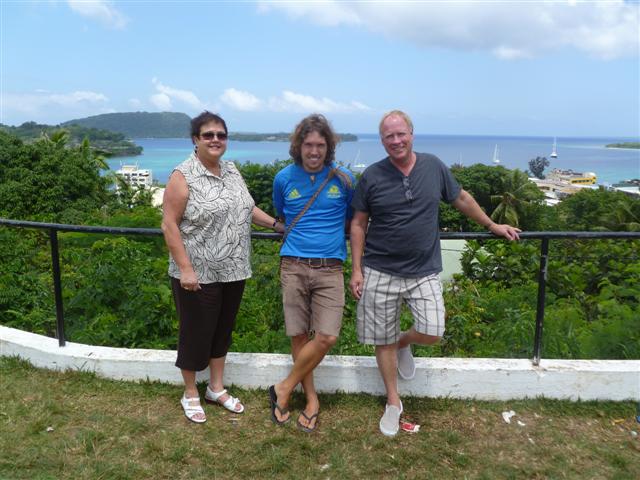
Well, I figure many people were waiting for the recap of my Parent’s visit to Vanuatu (because, obviously, I have many die-hard readers) and I am ready to present the epic story now – only about 3 ½ months after the fact, but that is an inevitability of my living situation (possibly my work ethic too). Without further ado, the story of The Rents Come to Vanuatu…

“I heard you almost killed Mom, at least that’s how she made it sound… She is a first world mother!” My brother yelled at me after I had failed to get my Parents to Maewo. He was in the midst of criticizing my decisions over the phone as I sat in the Volunteer Resource Center at the Peace Corps Office in Port Vila. I must concede that he was correct on most every count. Moreover, I was overly optimistic. Surprising that, I never figured that a year removed from my Mother and in the Peace Corps – at the end of the road and the middle of nowhere, but somewhere to somebody – would make me an eternal optimist and forget what most people deem necessities (flushing toilet, air-conditioning, running water, etc.). This is even more ironic because, while many things do work out in the end in Vanuatu, you still face many obstacles and barriers that can break down even the strongest resolve, leaving the eternal optimist lying in the fetal position muttering about the dire need to have a pizza. I can only guess that the constant challenges make any positive success ten-times better and thus, you just start expecting success to forget the negatives and always look for the silver-lining (either that or go insane and start screaming for air-conditioning and that ephemeral Dunkin’ Donut’s Iced-Coffee). My only defense was “she obviously ignored my warnings”, but that is not new, so that defense leaves me standing on shaky ground. I have to say though, I’ve tried very hard to truly convey life in Vanuatu through my blog; these, ostensibly, were completely ignored. Though, I’ve been told, my Sister reads these blogs to my Mom, which they obviously took as fanciful tales from a boy with too much time to think – this is a fallacy and completely untrue. Now, I will state, anyone who decides to come visit, “Heed the blog or suffer dire first world withdrawals!”

72 hours prior to phone call… October 14th. 2011

I sat on the lava rock beach that is Central-West Maewo, a nice deluge cascaded down on Nic Thiltges and myself. It was 7:15 AM. We were supposed to leave at 7:00 AM, but the boat had not come yet. We were quite surprised, as the boat driver, Basil, a trusted family-member of ours who we always ask to take us to Ambae, was never late – actually, many times he was early; but today he was late. I had called him and failed to reach him. We saw no motion down by the boats in the village down the way. Finally I reach him and he tells me that he is waiting for the rain to stop. Alright, so we wait. At 7:45 AM we finally depart Maewo for Ambae. I’ve now realized that I probably won’t reach the Longana Airport before my Parent’s flight lands. We reach Ambae and without enough time I run to the Post Office, get my packages my family sent months ago, and hand them off to Nic. Next, I run to the bank to withdraw the money for the boat trips. There I wait an excruciatingly long time as the staff does their best not to hurry – not really a surprise, but, in the stress of the moment, my inner-American is coming out. Finally, everything done, I go to catch the truck Basil chartered to take me to the Airport to meet The Rents. I then proceed to wait an extended period of time as the truck driver goes to do something that he describes very vaguely. After some more excruciating minutes we are off and slowly rolling. The roads are 1) destroyed from heavy rains and use, and 2) under-construction, thus we have to take the back-roads to the Airport adding more minutes to the time my Parents have been sitting at the Airport waiting on me, but, finally, we arrive. Hugs and kisses are exchanged, pictures are taken, excuses for tardiness tossed aside in the throes of happiness. We get into the truck and head to Le’ Mousse – the local Wal-Mart – for some lunch.

At this point I tell The Rents the bad news: the boat cannot make the passage to East Maewo; basically, we cannot reach Naviso – my village. To backtrack a little bit, the day before – hell, the whole week before – I sat on the lava rock beach in a deluge, we had nothing but sun; now overnight the rains had come, but this is not what cancelled the trip. Rain might have made the trip unpleasant, but not impossible. What made the trip impossible was that overnight the wind changed. The wind now came barreling down from the North making the waters quite messy. Now the trip from Maewo to Ambae was not particularly bad – I’ve been in much worse – but the passage between Maewo and Pentecost – leading to East Maewo – is aptly described as violent seas during the best of times. This is mainly from the entirety of the Pacific running into Vanuatu and then being funneled between the two islands. I was never expecting a nice trip, but I was expecting it to be possible; this was no longer true. Of course, disappointment was evident for The Rents had come all this way to see my village. I explained that that would not be possible, but we can still go to West Maewo and I would go get everybody from Naviso and bring them back; I was forced to go back because I didn’t plan for failure and thus left my entire luggage for the rest of the trip (Port Vila and Australia) in Naviso. At least this way they would reach Maewo and I could bring my family to come have a look at The Rents – this was not to be, but that part of the story will come. The Rents refused to concede to the impossibility of not reaching Naviso, but I believe they thought the impossibility was due to unpleasant weather and not a life or death situation (not to be over-dramatic); besides, they hadn’t seen the boat yet. After seeing the size of the boat the point was conceded.

Lunch consisted of the great, varied cuisine available in Saratamata (Penama Provincial Center): Peanut Butter and Jelly sandwiches. I have to admire the irony of bringing my Parents all the way to the other side of the world and eating PB&Js with them. Considering the promise of delicious island food and chicken or pig, PB&Js just ices the cake.

We sat at Le’ Mousse eating while our truck driver once again took off on some ambiguously described errand. Finally, just as we had decided to take another truck and were loading our luggage, our first driver showed up and he ended up taking us back to Lolowai and the boat. Once in Lolowai, we started loading the boat and before long we were off.

“This isn’t so bad!” comments my Mom, disparaging my earlier warnings that the seas are usually rough and the boat ride won’t be pleasant (THE BLOGS!!!). Of course, this comment was made while we were still in Lolowai Harbor. Once we hit the Pacific Ocean my Mom was slammed by a beautiful wave and immediately soaked through with saltwater. After this it was a matter of restraining my laughter. Unfortunately, as soon as I got my laughter somewhat controlled my Mum’s face went deathly white. At this point I went into serious, “try and not kill Mom” mode and started asking what was wrong. She was feeling incredibly nauseated and looked about to meet her maker, breath her last breath, give up the ghost, depart this life – you get the idea. I immediately start asking her if we should turn the boat around. We are probably about 10 minutes, at the most, outside of Lolowai Harbor and if we’re going to turn around, now is the time. “I don’t know” she said. “Do you want us to turn the boat around? Can you make it?” I responded. Not surprisingly, this went on for awhile until finally I got the response “I can make it, but I might die” – now that is not verbatim, but to the best of my memory it was something along those lines. So, we turned the boat around and headed back to Lolowai Harbor and I began formulating a plan because I still had to get back to Naviso to get all of my things. In the end, with the help of fellow PCVs (Megan Burrows, Mac Bradley, Nic Thiltges, Lindsay Templin, and Melissa Burns – Thank you), we took The Rents to the James Bule Guest House, behind Megan’s house, and I headed back, on an evening trip, to Maewo.

48 hours prior to phone call… October 15th. 2011

6:00 AM. Central-West Maewo. I am waiting for Kato (deep-fried dough – similar to a doughnut – an island donut). Kato that was seemingly ordered the night before, but I am geared to go because I have to get to Naviso, explain the dilemma to my family in Naviso, and then walk back to Northwest Maewo, catch a boat, and get to the James Bule Guest House before dark… There is no Kato… Nic’s Host Papa had sent one his daughters to find the Kato… She cannot be found…

7:00 AM. Central-West Maewo. I am still waiting for Kato. Well, I’m not waiting anymore. I start getting ready to go. I’ll walk to the other side on an empty stomach. Truth be told, I was never planning on eating, but Nic’s Host Family feels obligated to provide food for me and I don’t want to insult them. Still Waiting…

7:15 AM. Central-West Maewo. I’m heading out. I can’t wait any longer. I am prepared to offer insult. Before I get out of sight of the houses, Nic’s Host Papa comes running at me with a plate of rice. I am instructed to eat on the road and just leave the plate on a particular stump. Ale.

7:23 AM. Central-West Maewo. Rice finished, have no idea what stump they were talking about, drop plate off on side of road.

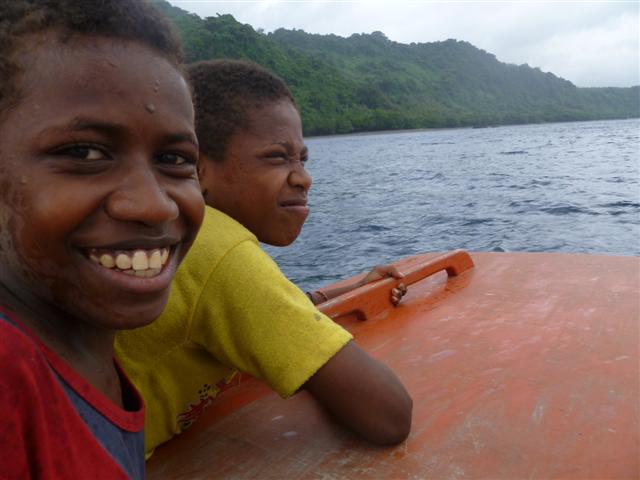
10:00 AM East Maewo. I made it to Naviso in record time. I have to share the sad story – of why The Rents are not with me – with everyone I pass (a little depressing). Finally, I reach my house and find my Host Family. They’ve decked out my Brother’s half-built house and set-up a dining area for me and my Parents. I sit down to eat the delicious meal they prepared of taro, snake bean, green onions, and diced chicken (DELICIOUS!). I share the sad story again and start packing my things for the next trip. Once everything is ready, I am told that two of my Brothers, Denilson and Pato, will help me carry my things to the other side.

10:40 AM. East Maewo. After a talk with Jennifer at her house, I head back towards the other side. I meet Denilson and Pato on the road and we take off to Northwest Maewo.

1:00 PM. Northwest Maewo. We made it in record time again and are now waiting on Basil who decided he would come at 1:30 PM opposed to 1:00 PM (as I had believed). During the walk over to Northwest Maewo, I asked Denilson and Pato if they wanted to come visit Ambae and then come back the next day (Basil was going to spend the night on Ambae); now, taking two pre-teens to another island and neglecting to tell their parent might be frowned upon in the states, but not so in Vanuatu (hell, it’s practically encouraged) – not to mention that they had never left Maewo before. So, at 1:30 PM we were on our way back to Ambae.
When we reached Ambae, I headed to the store, bought some foodstuffs, and some sandals for myself, Denilson, and Pato. After this, due to a lack of trucks, we made our way to Saratamata with all the PCVs I had mentioned earlier – minus Megan because they were on their way to meet her. Twenty-minutes later we arrived at a store close to the James Bule Guest House, bought some chocolate milk (a must – they have an ice box, that is relatively cold, most of the time) for myself, Denilson, and Pato, and the three of us left the PCVs behind and headed for The Rents.

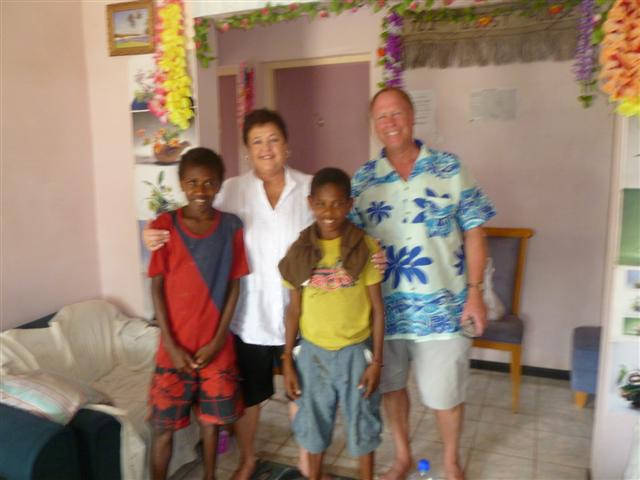
Once we arrived at the Guest House it was already getting dark and in the porch lights I introduced Denilson and Pato to The Rents. My two Brothers presented my Parents with all the Baskets and Mats that my Vanuatu Family had made for them as gifts. After this we started making preparations for dinner while my Mother proceeded to yell in English at Denilson and Pato (this was a constant theme that I found hilarious, especially because most of it involved telling them how ugly my long hair was).

As my Dad and I cooked the random assortment of food in the Guest House kitchen, we encountered a problem: a can of beans, but no can opener. To my Dad, this seemed to be an insurmountable problem. I assured him it would be alright and when my Mom arrived with Denilson and Pato, I asked them how they would open the can in Naviso. They told me with a knife. They took the first knife I proffered and, with my Mom in shock and a few quick stabbing motions, opened the can in seconds. After this, we ate and relaxed and I was able to put on some movies with my laptop. Additionally, I was able to hear all about my Mom’s observations of Vanuatu – “this place is like a third world country”, “they live so primitive, I just can’t understand it”, “they all just sit around not doing anything” – and experience without air-conditioning, hot running water, and electricity – “you had to shower with a bucket and flush the toilet with a bucket”. To me, this Guest House was one of the nicest places I have stayed on an outer island. If the water had been running, they had hot water and electricity, I would consider it a nice place in Port Vila, but my mind has obviously been tainted.

24 hours prior to phone call… October 16th. 2011

The following morning involved waking up to the sun – inevitable in the South Pacific without air-conditioning. I then spent the following hour trying to learn when Nic was going to Lolowai, so I could take Denilson and Pato to the boat with him. Of course this seemingly simple task is complicated by the ever-changing programs of the truck drivers (these distractions can range from transporting patients from the hospital to the airport to stopping to eat and sleep). When Nic finally arrived I got about 5 seconds of notice – this involved a phone call where he stated “Where are you? The truck is here.” Well this put me in a little bit of a panic has I had been waiting on his “the truck will be there in 5 minutes call” to get everything ready, so I quickly grabbed everything and herded Denilson and Pato towards the truck. After running the necessary errands in Lolowai, I walked back to Saratamata and thus began the final trial on the outer islands: the truck ride to the Longana Airport.

While in Lolowai, I had asked Joe, a local truck driver, if he could take me and The Rents to the Airport in the afternoon. He gave me the affirmative, but added that another passenger on the same flight had already chartered him, so he would pick them up first and then proceed to get us. With this guarantee, I went back to the guest house to pack and await our trip to the airport and the air-conditioning of Port Vila.
The trouble began when a fellow guest at the Guest House, who also was on our flight, took a truck to the plane much earlier than I had planned for our pick-up. There seemed to be a disagreement about the check-in time and thus the departure time – the other guests believing the plane was leaving earlier. As you can imagine, this can create problems, especially with my Mother’s insistence that she get off the island: “I am not going to miss this flight Nik.” Affirmative Mom. She might have threatened my life too, but I can’t be sure – she at least would have made my life rather unpleasant. Anyway, I stuck to my guns and assured them everything would be alright – though I was now a little apprehensive.

On a tangent, in my experience, this happens quite frequently – people stating that their flight is an hour earlier then what it says on my ticket – Judging that, usually, one plane comes to Ambae – when it does come – it is impossible for them to have a flight one hour before mine. It seems as if people don’t ever read their ticket or they don’t have one – only having a booking number for check-in – and are going off memory, but without fail I have yet to be wrong on the time because every time I look at my ticket.

Thus, we waited… And waited… Waited some more… And waited some more. The more we waited the more death threats I received from my Mom (not really, but she definitely was undermining my confidence). My apprehension wasn’t helped when Mac (fellow PCV also on our flight to Port Vila) called me and asked where we were – she had already arrived at the Airport. All this while I was repeatedly calling Joe and beginning to feel like I was annoying him. Probably because he kept telling me he was 5 – 10 minutes away; but I failed to see or hear his truck – on an outer island, it is pretty easy, with the lack of any significant background noise, to hear a truck. This went on for an unpleasantly long time and then Joe finally arrived: his truck was fully loaded – well how the hell am I going to get my Mom on that. With unflinching audacity, my Mom walked straight to the cab and tried to get in, seemingly unaware that a woman was already there. As she opened the door she was told that the woman was sick and had to ride in the front. That left only one option: riding in the truck bed. Well this was going to be interesting, but, apparently due to her desire to get off Ambae and back to air-conditioning and running water, she didn’t question it and tried to get in the back of the truck. With my Dad pushing from the back she tried getting in. In hindsight, I realize that the other occupants of the truck were incredibly unhelpful, going against the general character of Ni-Vanuatu, but I blame this on spending too much time in Provincial Centers and being used to the more adventurous type of tourist visiting Ambae. In hindsight because I was too busy listening to my Mother’s frustrated tirade directed at my Dad and me. Some unflattering things were said before my Mom made it into the truck bed, but before I was able to jump in who rolls up but another truck – with no one but the driver. I immediately go and ask the driver if he can take us. With an affirmative, my Mom gets out of the first truck – a much easier task – and into the big, double-cab, air-conditioned, brand-spankin’ new truck (owned by one of the Cooperative-Stores of East Ambae). It always works out in the end – there’s that damn silver lining. We are off to the Airport and Port Vila.

Thus ends this narration. The best word to describe the Maewo attempt would probably be disaster – I used that adjective quite frequently in the following weeks. This outer island trip resulted in the most stress I’ve experienced in more than a year -- that’s the accumulative stress of the past year. Of course, much of this cynicism is in the interest of humor – I can’t think of any people that I would want to experience a mental breakdown with more than The Rents…

Wednesday, October 26, 2011

Kiaman Stories

Kiaman (or giaman) means to lie, liar, false, fiction, not real. Frequently, in Naviso and all-around Vanuatu, you hear these “kiaman stories”. They are a product of “coconut wireless”. When communication is so difficult, people gossip as much as possible when they get the chance and tell the story the best they can remember. As you can imagine, like the game telephone, this results in many falsehoods, tall-tales, and crazy stories; one example includes a Brazilian nuclear submarine arriving on the western coast of Maewo. Three, in particular, have struck me as amazing. Now I can share these amazing “kiaman stories” with the world.
The “JB” Package
Once upon a time I was sitting at the kava bar in Naviso listening to the kava and relaxing when some guys arrive from the other side and sit down next to me. They start to “storian” (storian = talk, chat, etc.) about the happenings on West Maewo and eventually come to a point of contention. Inquiring, I learn that there is a package in Nakoro, West Maewo, with the address: Naviso Village, East Maewo. But the name on the package says only “JB”. They start listing off possibilities of what the “JB” could mean and I, eventually, suggest that it could mean Jennifer Blount: JB. They respond nonchalantly and seem to brush off the suggestion. I agree, thinking that no one would address a package to Jennifer with just JB and Naviso Village.
Weeks pass and I start to hear stories about a package for Jennifer in West Maewo. I hear no confirmations and sometimes hear that the package is not actually there. Another week passes and I hear more and more stories about a package for Jennifer on the west side, but no one has carried the package to Naviso. The stories change and people start telling me that the package must be for Jennifer. Still, no one carries the package over to Naviso.
Another week passes and I am sitting down with some Mamas and they tell me that there is a package for Jennifer in Nakoro on West Maewo. I tell them: I have heard there is a package there, but no one has brought it over. They tell me there is a package there, they will get it when they go over, and, finally, there is a package… I have seen it.
More time passes and no one brings the package to Naviso, but I am headed over to the other side and will grab it on my way through and bring it back. I reach Bertarara, immediately find the postmaster, Paul Wrenn Tari, and ask after the package. He responds succinctly: I have heard about this package (word has spread), I do not know where this story started, but there is no package… Ale! Well, I am not sure what my Auntie saw, but it sure was not a package.
The Purse
Purse noun, verb, pursed, purs•ing.

Noun

1. a small bag or pouch, often made of soft leather, for carrying money, esp. coins
Purse, wallet, pouch, all of these can describe something that carries money, identification, credit cards, etc. In Maewo they refer to it as a purse and thus the story begins…
Once upon a time, at the end of August, Maewo hosted the PISSA games (for the first time). The PISSA games are a provincial secondary school sports tournament (including Soccer, Beach Volleyball, Basketball, Futsal, and Netball). I believe PISSA stands for Provincial Inter-Secondary School Athletics, but I could be horribly wrong. The PISSA games were held at Gambule Secondary School in Bertarara, West Maewo (close to Nakoro). Anyway, I attended part of the PISSA games and found that I lost something I never knew I had.
The day I arrived at the PISSA games, I met up with Nic, Jennifer (who had left the day before), and Melissa (who had followed her school, St. Patrick’s College, to the games). We immediately went to one of the various food stalls. We, of course, went to the one with ice cream. I have never seen ice cream on Maewo before. This ice cream was brought all the way from West Ambae. Anyway, shortly after leaving the stall, I was approached and asked if I had forgotten my purse. As soon as I understood what they meant, I quickly checked my island basket for my wallet. They were both there safe and sound. I told them I had, in fact, not forgotten either purse. At this they left, but I distinctly remember the conversation being strange and awkward, but I am not sure why.
As the days passed, I was regularly accosted and asked about my lost purse. Repeatedly, I told everyone that I had not lost my purse. Soon the story became that I had lost my purse and it had my name on it and my picture in it; neither of these are true of my wallet and yet the story continued. Again and again they asked after my lost purse with my name on it and picture inside. Again and again I told them it was not me.
One day, I found myself sitting on the Nakoro wharf and calling home to America. As I was talking to my brother a boat arrived. The boat driver interrupted the conversation to tell me that he was the guy who had found my purse with my name on it and picture inside. Surprised, I tell him: no, sorry sir, but that was not me. You would think that, if a picture of the owner was inside the purse, he would know that it was not me. Alright, there are five white people on Maewo normally, at PISSA there were seven. Only four were guys. That means he would have to remember the distinctive face of one of four white guys at PISSA; this is ridiculous.
As I make my escape from PISSA later in the week (you can only take so much high school sports and kava), I head back to Naviso to have some much needed rest and reading time. When I arrive in Naviso, I start to storian with my neighbor Mama Hanson. We storian go go and suddenly, Mama Hanson, who had left the PISSA games before I arrived, tells me that she heard I had lost my purse with my name on it and picture inside. Unbelievable, word had spread incredibly far and very quickly. Chances are very good that the entire island of Maewo believes that I had lost my purse at the PISSA games, no matter what I tell any one person to the contrary.

The Black Magic Man and D-Day
As I walked to the PISSA games, I was instructed on the history of America’s victory in World War II. As I walked to the top of the mountain, on my way to Ngota, an uncle of mine, Davis, told me a little story about the happenings on Maewo during World War II. Storian i go olsem ia:
Once upon a time, East Maewo had a man and this man had a sickness and a smell that was intolerable (the description sounded like leprosy). The village decided that he needed to leave, so they exiled him to the bush, but this was not enough as they could still smell his intolerable smell. Thus, they made him go on top of the mountain to middle bush, where he lived, by himself, until the Americans came. Apparently, the U.S. Army learned about this man and had also learned that he was a powerful sorcerer and had great magical powers. Of course, the U.S. Army desired his powers and came with helicopters and caught this man by throwing a net over him (so much for those magical powers). The U.S. Army took this Sorcerer back to America (where he lives to this day) and his powers are why the U.S. was victorious in World War II. Moreover, his powers still make America the World Superpower it is today.

I have heard this story three times now. The second I was being asked if this story was true and then I heard the story from Nic on West Maewo (his story had changed a little bit, but the essence of the story was the same). For a culture that claims America saved them from the evil Japanese during World War II, they are not humble in this regard. But I had lived in America for 23 years and have never seen this super powerful leper.

Sunday, August 7, 2011

Project Report: STI & HIV/AIDS Awareness Program for Rural Vanuatu (NAC 149)

On July 11th, 2011, the workshop Wanem Nao HIV/AIDS mo Sik STI began. The workshop would include talks about sexual reproductive health, STIs, and, ultimately, HIV/AIDS. Before this could happen though, I needed to bring in help from the outside. On the 8th of July, I left Naviso, East Maewo and made my 4-hour trek to West Maewo. In West Maewo, I stayed one night before going to East Ambae to bring in fellow volunteer Nancy Miyake, who had worked in North Ambae (now with Save the Children in Port Vila). After leaving East Ambae, we made one more stop in South Maewo, Baitora, to bring Lindsay Templin. With two more Community Health Volunteers (both female), we made our way back to West Central Maewo and stayed one more night. On the 9th of July, the three of us made the walk back to Naviso via a bush road from Telise Village. A little over 5-hours later, we arrived, wearied and dirty, in Naviso.

The following day, July 10th, we collectively went to Church in the morning and afterwards I was able to make my community announcements about the workshop: beginning on Monday and going through Tuesday. Prior to this, I had been conducting a 4-week media campaign promoting the workshop. This involved repeated reminders during community announcements after church, various flyers, and talking with the community. Leading up to the workshop, I could feel a palpable excitement; people were continually asking questions about the dates and times. After announcements, I had to make some final arrangements and later in the day the other volunteers and I would make preparations. I had to make sure the pig, two roosters, rice, and other kakae was ready for the next two days. Additionally, I had to meet with the Youth Committee that was supposed to perform my drama tomorrow during the workshop – this requires some storytelling:

Two weeks prior to my workshop I searched out 8 – 10 people to help me make a drama visualizing the affects of HIV on the Immune System. I finally got a list of names and set two days to meet before I would go to Ambae to get the other volunteers. These two days would be used to prepare and practice the drama. The first day we were supposed to meet at 7 AM. Of course, being American, I arrived promptly at 7:00 only to wait until 8:45 before everyone showed up. After this, the leader of the Youth Committee, Esron Boe, told me that he would be going to Lalaone in North Maewo to make Copra and would miss the next practice, but would be back before the workshop; this was my first problem I ran into – I did not see him again until July 20th.

In his stead, Ephram was charged with leading the group and Ephram seemed motivated and interested in adding to the drama to improve the entertainment quality. The next time we were supposed to meet I did not want to wait a long time; I decided to come late and meet the late ones halfway. I arrived at 7:45 and found no one. I waited until Ephram came down and told me that they had been there at 7:00 and waited, danced, and finally, assuming I was unable to come, left. Well that did not work. Ephram decided that we could meet the next day, in the morning, before I left for West Maewo and Ambae. The next day I showed up promptly at the Nakamal, after Morning Prayer (as stipulated by Ephram) and, again, found no one. Opposed to waiting, I went to Ephram’s house to find him asleep – he had a kava hangover and had missed prayer. He told me that he would grab everyone and meet me at the Nakamal. About 10 minutes later, I was met by Ephram with bad news: ol man oli lus (All the people are gone). Ok, we decided that we will meet after Church on the Sunday before the workshop, July 10th.

This brings us back to the Sunday preparations. After Church, I find Ephram and he tells me that he will find all the people and get me from my house and we can practice. So, I go back to my house and wait. I do not see Ephram again until that night drinking kava. At this point, I tell him, since we had met once, the participants know the drama and I just need them ready to act on the second morning of the workshop.

Jumping ahead, on the second day of the workshop, July 12th, I go and get Ephram in the morning and tell him to get everyone ready. A small time later, Ephram comes and tells me, once again: ol man oli lus. Well, lucky I am used to this and found willing participants to come and act impromptu. Lesson Learnt: Locals can, but I am not allowed to work on ‘Island Time’.

Now, we can get back to the meat of the story. The preparations were finalized on Sunday, as Nancy, Lindsay, and I went over the workshop details and prepared the Reproductive Health materials – at the same time, making sure we understood how the sexual organs worked ourselves. Once we were all on the same page, we were ready for the workshop.

July 11th, 2011: Day 1 – Sex and Ni-Vanuatu

We began the workshop with an opening prayer and the Bananas Dance Ice Breaker. After this we went outside and played a massive name game. By the time we finished this and went back inside, attendance had boomed and we had somewhere around 70 – 80 people of all ages in the Church. We began the day by splitting the groups into two (males and females) and using picture activities to learn about reproductive health. This took up much of the morning, but before breaking for lunch, we had the groups split into two again (after learning this activity would not work with males and females together) to define what ‘sex’ means. This was an eye-opener and a funny activity; I no longer believe that Ni-Vanuatu have reservations about sex.

After breaking for lunch, we came together again and started the STI talk covering: STI i minim wanem, Wanem ol nem blong sik STI, Wanem ol saen blong sik STI, Hao nao blong blokem sik STI, and i gat meresin blong sik STI. Following these talks, we went into a picture activity that involved some critical analysis of family planning methods. Finally, we closed the day out with a talk from the Nurse, Nicholas Bage, about the services offered at the Mamalu Vanua Dispensary (family planning, STI treatment/medicine, condoms, etc.). After, the workshop was closed with a prayer, thus completing day one.

July 12th, 2011: Day 2 – HIV/AIDS and Gender Play

The second day of the workshop began with a fruit salad dance followed quickly by an outdoors activity: Telephone. Yes, the classic game of telephone, where you try to pass a message down a line or in a circle and see what comes of the message in the end. The activity was meant to represent the importance of learning correct information and how toktok blong rod can lead to misunderstandings and problems. Following this we went into the first section of the day.

Wanem nao HIV/AIDS?
The day started with the Immune System talk and the Drama, showing how HIV attacks the white blood cells and how other diseases can enter the body without resistance. After this we went through the activity: Laef Laen blong Sale (Sale’s Life). I used a clothes line with different signs to indicate age groups and life events. I demonstrated how HIV/AIDS can cut your life short; this was emphasized by cutting the clothes line and having every sign fall to the ground. This part turned out to be surprisingly dramatic as the signs hit the ground. The next activity covered the meanings of HIV/AIDS. We closed this section with an activity called ‘Finding the Ball’. In this activity the participants made two lines (males and females), shoulder-to-shoulder, and passed a ball back and forth up and down the line. After the facilitator said stop, the other group would have to guess where the ball was in the opposite line. This activity was meant to demonstrate how HIV does not have any signs and you cannot just assume anyone has or has not contracted the virus. After this we went into the next section of the day.

Hao nao yu serem HIV/AIDS?
This section was complete with picture activities that allowed the participants to explore the answers to each question. This developed great climates for discussion. The two activities explored what waters of the body HIV could pass through and what were the chances of sharing HIV in different activities. Following this we had a talk about the different general activities that would share HIV based on the waters of the body: Sex, Breastfeeding, Blood Transfusion, Bloody wounds, and Having HIV and being pregnant/giving birth. At the completion of this section we broke for lunch.

Hao nao yu save blokem HIV/AIDS
After lunch we began with another Bananas Dance and a game entitled: Juggling My Life. During the game participants stand in a circle and throw different objects around. The facilitator continually puts in more objects (the objects meant to represent life’s responsibilities), after a small time, the facilitator introduces a bigger object and three smaller objects meant to represent sex, pregnancy, STIs, and HIV/AIDS. The activity is supposed to demonstrate the difficulty of juggling your responsibilities and how sex, a bigger responsibility, can lead to different consequences that individuals might not be able to manage. Following this we went into a pictures activity to explore different ways for blocking HIV transmission. After this we touched on the poster with different ways to block ‘sik STI’ from the previous day. After this came the String Activities that used string and circles of participants to show the ease of possible HIV transmission between groups and islands throughout Vanuatu. Finally we went into condom steps and practice, using male condoms only, as female condoms had not reached Lolowai Hospital in East Ambae when we had last passed through. The condom work closed out the section blocking transmission.

Closing Activities
After the last activities, that were done in separate groups (male and female), we came together again to participate in a Gender and Development activity called: The Thing Game. The males and females were set-up as teams on either side of the Church and told that, exchanging turns, people from each group could come grab from the pile of ‘things’ and women would “act like a man” and men would “act like a woman”. While they did this we would record each activity. These resulted in a great amount of laughter with men pretending to breastfeed and give birth and women pretending to act drunk and rowdy, put on male condoms, and drink kava. The activity was followed by a debriefing session that touched on the multiple responsibilities that men and woman shared and how using a condom was a responsibility of everyone: Yumi Evriwan gat Raet blong karem Kondom. Finally, we finished the day’s activities with a talk about the difference between treatment and cure and how testing worked in Vanuatu.

As a group, the other volunteers and I answered all the questions from the ‘question basket’ that had been collected throughout the workshop (the first day’s questions were answered in the morning). Following this, the workshop was ended with a chorus and a closing prayer. Afterwards, the community made a ‘Thank you’ ceremony/lafet and killed another pig for kakae. The volunteers and I were presented with Salusalus and drank kava with the Chief. The village performed a small custom dance and everyone brought in local kakae too. The celebration was a big one and made for a great ending to the NAC-funded workshop in Naviso, East Maewo.

Success Story
In a small tangent, I can tell you the story of one Auntie of mine who, following the workshop, approached Nancy and explained to her: after going to the workshop, she discussed with her husband and they had decided to start using condoms. She asked Nancy if she could get her some condoms and Nancy passed the information to me. Later, I was able to get her the condoms she had asked after. This is explicit proof of the need to make these workshops with facilitators of different sexes and the importance of volunteer collaboration.

NAC-Funded HIV/AIDS Workshop: North Ambae July 17th – 18th

Summary: The Benefits of Volunteer Collaboration
After the workshop in Naviso was completed, I followed Nancy Miyake back to her site in North Ambae to assist in facilitating her workshop. The workshop was designed similar to the workshop in Naviso and Nancy and I changed sections based on what worked and what did not work in Naviso. Moreover, we added new sections to test in North Ambae. Nancy’s workshop involved three different villages in North Ambae. The experience was rewarding and the community opened up well to me during talks about sex and other sensitive issues. Nancy’s workshop was benefited by the presence of Rolingson Tari, the PENAMA Provincial STI, HIV/AIDS Officer, and his counterpart, VSO, Eric Ochieng, a volunteer from Kenya.

The workshop in North Ambae was very successful and I believe without the collaboration between Nancy and me before the workshops, at a PEPFAR-funded workshop for Village Health Workers, and before/during the workshop in Naviso, the end result would have been quite different and nowhere near as successful. I believe collaboration between volunteers is necessary for growth and this can be seen explicitly in my work with Jennifer Blount, the education volunteer in Naviso, and my work with Nancy on the HIV/AIDS workshop. These things could not have been possible without PEPFAR and NAC Funds and the backing of Peace Corps Vanuatu staff. The next collaborative workshop will take place on September 18th in Baitora, South Maewo. With the cooperation of so many volunteers these workshops can only improve and with them, the collective understanding of Ni-Vanuatu regarding all aspects of Sexual Reproductive Health, STIs, and HIV/AIDS.